Will Shohei Ohtani pitch in October? 5 questions for Los Angeles Dodgers

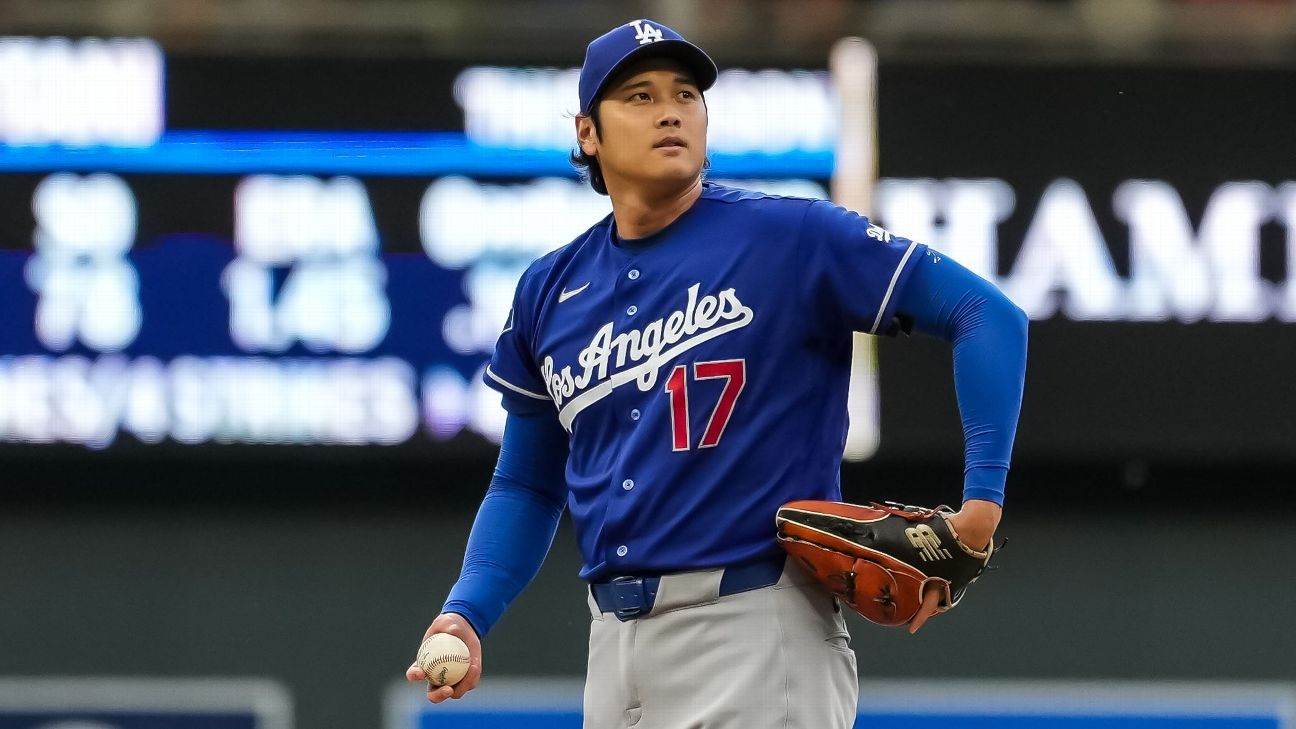
Shohei Ohtani was noticeably uncomfortable when he took his last at-bat in Wednesday's 10th inning. He swung through aRiley O'Brienslider with a noticeable lack of support from his lower half. As he retreated to the dugout -- in the wake of his fourth strikeout of the night, with his Los Angeles Dodgers on their way to a sixth loss in eight games -- he shook his right arm.
To some Dodgers officials, it was the first clear sign that the ailments preventing Ohtani from pitching for two months were bleeding into his at-bats. To Dodgers manager Dave Roberts, it was "the tip of the iceberg."
Ohtani was held out of the Dodgers' lineup on Thursday, his first absence since July 30, and described as day-to-day. A stint on the injured list seems unlikely. The hope is that one or two days off will be enough for Ohtani's body to recover to at least be unencumbered offensively. But the other side of his game lingers.
Ohtani has not pitched in a game since July 3 and has not thrown off a mound in seven days, when last Friday's bullpen session -- a potential precursor to him rejoining the Dodgers' rotation -- was cut short due to lingering soreness in his left knee and right bicep.
With the postseason less than a month away, the Dodgers face a major dilemma around whether to keep Ohtani's two-way ambitions viable for the stretch run. Eliminating the possibility of him pitching in October is not a decision the Dodgers will arrive at easily. He's that valuable on the mound, even in a limited capacity. If it's obvious that continuing to pursue pitching is impacting his offense, then their decision to shut him down as a pitcher will be simple. But that's something the team's principal decision-makers have yet to determine.
As is often the case with the most unique player in baseball history, the path is not straightforward.
Below are the five biggest questions for the Dodgers to consider when it comes to Ohtani's role for the final stretch of their season.
What do the Dodgers need most from Ohtani -- pitching or hitting?
Roberts left no doubt when asked that very question over the weekend.
"His value offensively is hugely important," he said of Ohtani, "and so we can't compromise that in any fashion."
Without Ohtani, the Dodgers would still possess arguably the best postseason rotation in baseball. They have Tarik Skubal, the reigning two-time American League Cy Young Award winner; Yoshinobu Yamamoto, who dazzled last fall and has put together another brilliant season; Blake Snell, who has pitched to a 1.17 ERA in four starts since coming off the injured list; and Tyler Glasnow, who has been just as sharp in his return from the IL.
The Dodgers' offense is every bit as decorated -- but nowhere near as productive.
Since the start of July, Dodgers hitters rank 22nd in OPS (.703), 23rd in runs per game (4.2) and 22nd in weighted runs created plus (94). Kyle Tucker, Teoscar Hernandez and Tommy Edman all slumped in August. Freddie Freeman went 47 games without homering before finally going deep again on Wednesday. And after posting the worst offensive season of his career last year, Mookie Betts has been even worse in 2026.
In other words: It's easy for the Dodgers to envision themselves winning a championship without getting any innings from Ohtani in October, a time of year when only four starting pitchers are required. But it's almost impossible to see them winning it all if he's not himself offensively. It's why Roberts said he's "very, very bullish on making sure we don't compromise the hitting."
Does pitching typically impact Ohtani's hitting -- and, if so, how?
This question has long been debated by the Dodgers, even when he's fully healthy. There are some who don't believe there's any meaningful correlation, while others -- players included -- believe the toll of pitching absolutely plays a part in Ohtani's offensive production.
The numbers are inconclusive.
If you go back to 2023, his last year as a full-time two-way player, Ohtani slashed .372/.490/.731 on his start days with the Angels. When he slumped last July, after settling into the rotation in the wake of his second elbow surgery, it raised eyebrows. But then he dominated in August and September, putting up a 1.091 OPS while his workload as a starter increased. On his start days this year, he has slashed .250/.372/.500. When playing the day after his start days, something the Dodgers have been trying to avoid, he slashed .250/.478/.500. On all other days, he has slashed .288/.383/.542.
Health changes that dynamic entirely.
"If you're not a hundred percent, there's possibly some bleed-in to the performance offensively," Roberts told reporters on Wednesday. "That's just me kind of theorizing."
Ohtani's recent slump -- seven hits and 20 strikeouts in his past 51 at-bats -- certainly lends credence to that theory. For much of that stretch, the Dodgers viewed it as a relatively small sample size that was more a product of bad pitch selection and just one of the typical lulls Ohtani will have in any given season. Leading up to this week, Ohtani had not expressed any discomfort to the Dodgers' trainers and coaches while hitting, according to Roberts.
Then came Wednesday's last swing, in which Ohtani experienced soreness on the right side of his neck and down through his arm.
It could change the dynamic entirely.
How much pain is Ohtani in?
"If any pitcher was feeling like this, we wouldn't run him out there," Roberts said when he announced Ohtani would not start on Sunday.
That's a pretty clear indication that he's not all that close.
Ohtani spent much of June managing pain in his left knee -- while still putting up a 1.091 OPS -- before finally agreeing to take a break from pitching. That it has been two months and the pain remains, even after the relatively light work of a 20-pitch bullpen session, is concerning.
Ohtani has tried to make adjustments with the position of his landing leg to ease some of the irritation in that left knee -- the same knee that was operated on to address a rare congenital condition called a bipartite patella in 2019 -- but they clearly have not worked. The right biceps issue that flared up on him several weeks ago has also resurfaced.
At this point, it would be a matter of pain tolerance -- but because he performs two roles, it's a lot more complicated.
"I just don't see everything getting to 100% by the end of the season," Roberts said of Ohtani, who has not addressed the media since Aug. 17. "But there's a lot of pitchers that are not 100% and still viable. It's just not an exact science."
What about running the bases?
As a two-way player for the Angels, Ohtani stole 57 bases from 2021 to 2023. In 2024, when he was strictly the Dodgers' designated hitter, he stole 59. By the end of April 2025, he had racked up nine steals, four shy of the major league lead.
Then Ohtani started to build up as a pitcher, and he just stopped running.
Ohtani made just 16 stolen-base attempts over the past five months of the 2025 regular season, 11 of them successfully. He has attempted 14 steals all of his year, including zero in June and July. So while there might be ambiguity over how Ohtani's hitting is impacted by his pitching, there is no doubt that his baserunning takes a backseat when he's juggling a two-way role.
Since May 2025, Ohtani has been worth 3.6 baserunning runs above average, still good enough to rank 25th among qualifiers; his speed and acumen still show up when opportunities to take extra bases present themselves. In 2024, though, Ohtani was worth 9.8 baserunning runs above average, second most in the majors.
Would putting a pause on pitching unlock this version of Ohtani for the stretch run and into the playoffs? It's safe to say he'd become more aggressive on the bases, to some extent. But how much does that really matter in the postseason, a time of year when runs are at a premium and teams are far less likely to risk getting thrown out on stolen-base attempts? And is it enough to sacrifice the potential impact of him on the mound?
As one high-ranking Dodgers official put it: "Absolutely not."
Is it worth it to keep his October pitching hopes alive?
It's clear at this point that Ohtani doesn't have enough time to build up as a traditional starting pitcher for the playoffs, and yet, he hasn't been shut down as a pitcher. There's a clear reason for that:
Even a handful of innings in the playoffs is exceedingly valuable.
Keep in mind Ohtani doesn't count as an extra pitcher, which means keeping him as an option won't cost the Dodgers anything. If he can, say, open for Glasnow as a way for the Dodgers to lessen the amount of innings that would have to be covered by their bullpen, that's a major plus. Or let's say it's the ninth inning of a decisive game and the Dodgers lead by a run or two. Having Ohtani in their back pocket -- in a world where Edwin Díaz still hasn't worked out of his struggles and Roki Sasaki is still troubled by a blister -- is invaluable.
Scenarios like that don't necessarily require firm timetables. Ohtani can continue to take his time, keep his arm active -- he's still working with plyometric training balls, even if he isn't currently playing catch -- and basically be available for that type of work, so long as he's throwing off a mound again before the end of September. Still, Roberts said Wednesday that shutting Ohtani down as a pitcher is "an option."
It's a decision that won't be made without Ohtani's blessing.
"It's his decision, honestly," Roberts said. "If he feels like he's capable, then we'll run the play out until it doesn't make any sense."br/]