How the rebuilt Pac-12 looks to be 'in a tier of its own'
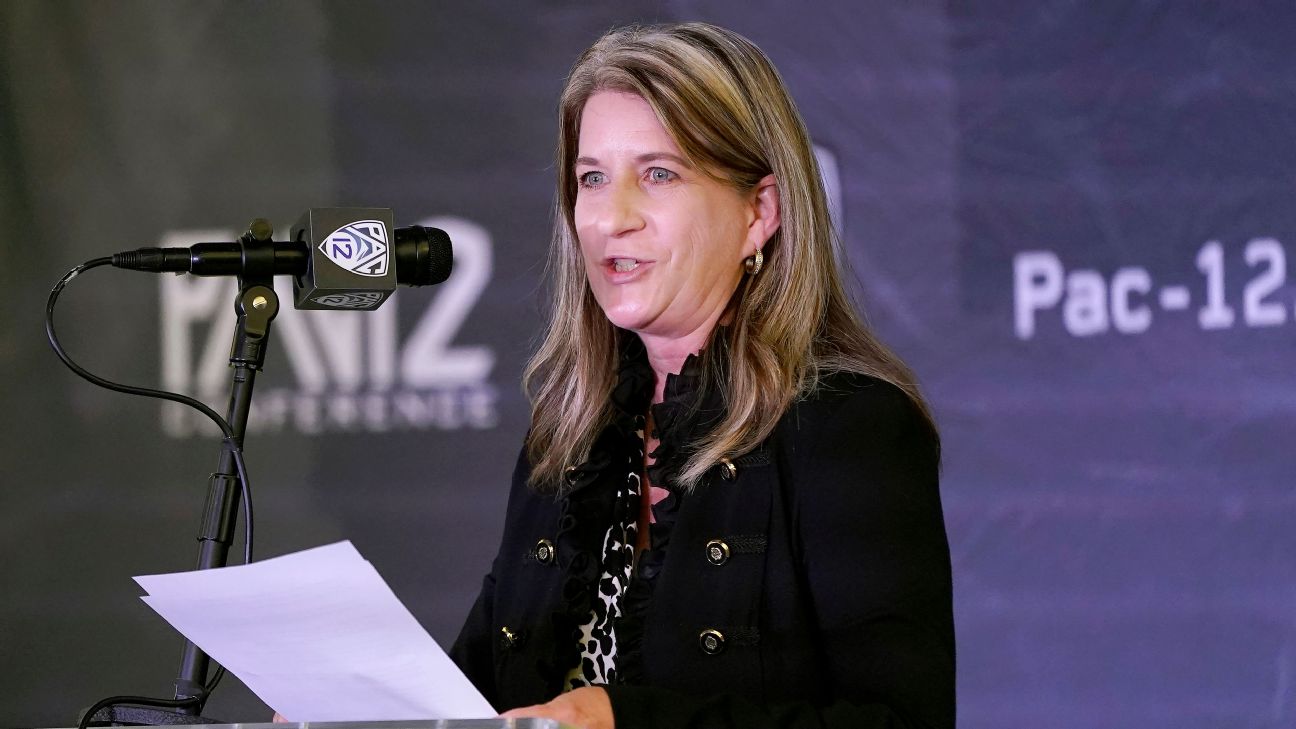

IN JUNE, INSIDE a nondescript office building about 35 miles east of San Francisco, Pac-12 commissioner Teresa Gould finally allowed herself, if only for a moment, to absorb what the conference had endured over the past few years.
The setting itself reflected how much had changed. The old Pac-12 had occupied over 100,000 square feet in downtown San Francisco, where its headquarters and television network burned through upward of $75 million in rent over 11 years. Its modest new digs sit in a suburban San Ramon business park, next to a middle school, medical offices and an assortment of other tenants for about 12% of the previous annual cost.
Two years earlier, Gould had asked roughly 30 employees to remain with the conference. She could not promise them the league -- or their jobs -- would still exist much longer, but they stayed anyway.
Now, gathered for a two-day staff meeting, Gould stood in front of the people who had helped carry the Pac-12 through its darkest period. The conference had preserved its assets, assembled a new membership and begun expanding its workforce again. Soon, athletes would wear the new Pac-12 logo and compete for Pac-12 championships.
"I was able to face those incredible humans that raised their hand and stuck in there with me and thanked them and acknowledged that it's because of them that we got to this place," Gould said.
But what, exactly, is this place?
The Pac-12 is back as a functioning conference with eight football-playing schools, plus Gonzaga in basketball and other sports. It is not the Pac-12 that existed before realignment led to its collapse, nor does anyone involved pretend otherwise. Around the conference, they like to say it's a 100-year-old startup -- a collection of schools trying to preserve the value of one of college sports' most recognizable brands while carving out a new place in a rapidly changing landscape.
For the past two years, success meant survival. Now, the new Pac-12 wants to be viewed as the strongest conference outside the sport's four richest leagues, compete regularly for College Football Playoff access, generate enough revenue and convince fans, recruits and the rest of college sports that this version of the conference matters.
The idea that the Pac-12 should be rebuilt was not obvious when Gould took over in March 2024. At that point, her two main priorities were to wind down the league's final year with 12 teams and help Oregon Stateand Washington State-- the only two schools that didn't find an alternative landing spot -- navigate possible courses of action.
But as Gould began talking with television executives, administrators and others across college sports, she said the message she heard was remarkably consistent.
"The number of text messages and phone calls and outreach for meetings where people were like, 'Please tell me you're going to save the Pac-12,'" Gould said. "And it was overwhelming the amount of people that were like, 'You have to find a way for this to continue. You have to find a way to reimagine it.'
"And then quite candidly, the inbound interest from prospective schools was also not only overwhelming, but it happened really fast. It was like within a short period of time after we transitioned the 10 outbound institutions, the amount of inbound interest that we had was incredible. And that reinforced what I was hearing in the marketplace, which is this brand is still really, really relevant. This conference continuing is really important to our industry and to the West Coast."
The rebuilt league drew most heavily from the Mountain West, adding Boise State, Colorado State, Fresno State, San Diego Stateand Utah State.Texas Statejoined from the Sun Belt to give the Pac-12 an eighth football-playing member. (There are 12 other affiliate members in baseball, men's soccer, women's gymnastics, women's swimming and wrestling.)
That composition makes comparisons to the Mountain West unavoidable. Pac-12 leaders, though, have emphasized that the new membership was assembled deliberately, with an eye toward schools they believe are willing to invest and capable of competing at a higher national level.
"This was a move about institutional trajectory, not just athletic trajectory," Gould said. "They wanted to be aligned with other institutions that want to invest, that want to compete at the highest level."
That aspiration is at the center of how the rebuilt Pac-12 wants to position itself. It is not trying to claim the same place the old conference held alongside the Big Ten and SEC. Instead, its leaders have made a point of arguing that the Pac-12 should occupy the next rung of the sport's hierarchy -- the strongest league outside the ACC, Big 12, Big Ten and SEC.
Officially, the new Pac-12 refers to itself as being in "a tier of its own."
The conference has backed that claim with a collection of metrics comparing the recent performance of its eight football programs with the rest of the FBS. Over the past five seasons, the Pac-12's future membership combined for a .537 winning percentage, which the conference says would rank fourth nationally behind only the SEC, Big Ten and Big 12. Six of its eight programs finished that span at .500 or better, and six have appeared in the Associated Press Top 25 at some point during that period.
The league also points to several advanced metrics that put its collective membership within the top five nationally. Its eight programs have produced a top-five average ranking in ESPN's FPI, SP+ and SportSource Analytics' Team Success ratings over the past five seasons. Five of the eight have appeared in the CFP rankings during that span.
The point of compiling those numbers is not simply to win an argument over conference rankings. In a sport increasingly stratified by money, access and brand value, Pac-12 leaders say they believe establishing themselves as the clear No. 5 league carries practical value with recruits, fans and media partners.
"Perception is everything too," Washington State athletic director Jon Haarlow said. "And so I think for our fanbase and for either recruiting purposes, to be in that top five I think is relevant for the narrative of positioning ourselves for the changes that -- well, I can't tell you what they are -- but changes that will come."
There is a belief around the Pac-12 that if its football programs continue to perform at roughly the level they have collectively in recent years, the conference should be a regular participant in the College Football Playoff -- whether under the current 12-team format or whatever expanded version might come next.
For Gould, that makes playoff access one of the clearest measures of whether the rebuilt league has established the place it believes it deserves.
"We certainly expect to be in the CFP conversation and have access to that kind of non-A4 spot year in and year out," Gould said.
But the reality is that with only one spot for teams outside the ACC, Big 12, Big Ten and SEC, conference strength doesn't play an outsized role in the selection process. The Pac-12 could, in theory, be the No. 5 conference -- top to bottom -- and still not get a team in the playoff. Even with that playing field, the CFP is a top Pac-12 priority.
"I think about it every day," Haarlow said.
If the Pac-12's description of itself as a 100-year-old startup is going to mean anything, the clearest early evidence might come in the final week of the football season.
The conference has designated Colorado State, Fresno State, Utah State and Washington State as home teams for four games on Nov. 28. But who they will play will not be decided until as late as a week before the games are played.
Those flex week games will be treated as nonconference matchups and will not affect which teams advance to the Pac-12 championship game. Instead, the league will have the freedom to pair teams according to what it believes is in the conference's best interest at that moment. College Football Playoff positioning will be at the top of that list. If the Pac-12 has an undefeated team in playoff contention, perhaps the league determines that protecting its record is most valuable. In another scenario, that same team might need a stronger opponent to improve its strength of schedule. And the considerations will not always involve the playoff. If two teams enter the final weekend at 5-6, for example, matching them against each other would guarantee the conference another bowl-eligible team.
Exactly how those decisions will be made remains a work in progress. That is partly the point. Rather than lock itself into rules written months or years earlier, the Pac-12 wants the ability to respond to circumstances as they develop.
"Let's make sure we don't bylaw ourselves into places that we're costing ourselves spots on a national scale," Haarlow said.
For a conference trying to establish a place in a sport increasingly dominated by four wealthier leagues, that willingness to experiment is less about novelty than necessity. Pac-12 leaders understand that if the rebuilt conference simply operates the same way others do, there is little reason to believe it will close the gap -- and a greater risk it will be left behind. But even as the Pac-12 tries to distinguish itself in the future, a main factor in its survival was its history: national championships, Heisman Trophy winners, Rose Bowls, rivalries and generations of athletes whose accomplishments took place under the Pac-12 and its previous iterations. Preserving that history is an obvious responsibility for the entity that still carries the conference's name.
It also presents an unusual dilemma.
Most of the schools responsible for that history now belong to conferences the new Pac-12 is competing against -- if not always on the field, then for market share, recruits, media rights money, etc. The league has reason to celebrate what USC, UCLA, Oregon, Washingtonand the rest accomplished as members of the Pac-12, even though its new members have little incentive to spend much time memorializing the successes of programs that are now their competitors.
Gould said the conference has no intention of abandoning that past.
"We would be foolish to not recognize that the Pac-12 brand has a ton of equity," she said. "That's why we're here in part."
The plan, Gould said, is to preserve recognizable pieces of the old conference while allowing new traditions to develop around its current membership. Pac-12 After Dark will remain part of the league's identity, and she pointed to the redesigned logo -- a familiar shield altered for the new era -- as an example of how officials are trying to balance what the conference was with what it is becoming.
"We will honor the past and celebrate the history and the successes and the traditions while at the same time understanding that it's a new league," Gould said. "We're reimagining it with new schools and new student athletes and all of those things."
That balancing act might be harder than redesigning a logo. The history gives the new Pac-12 much of its instant credibility. But eventually, for the conference to develop an identity of its own, Boise State, Washington State, Oregon State and the rest will have to create Pac-12 history that belongs to them.