Fresno State alumna's award-winning research explores new mosquito-tracking tool
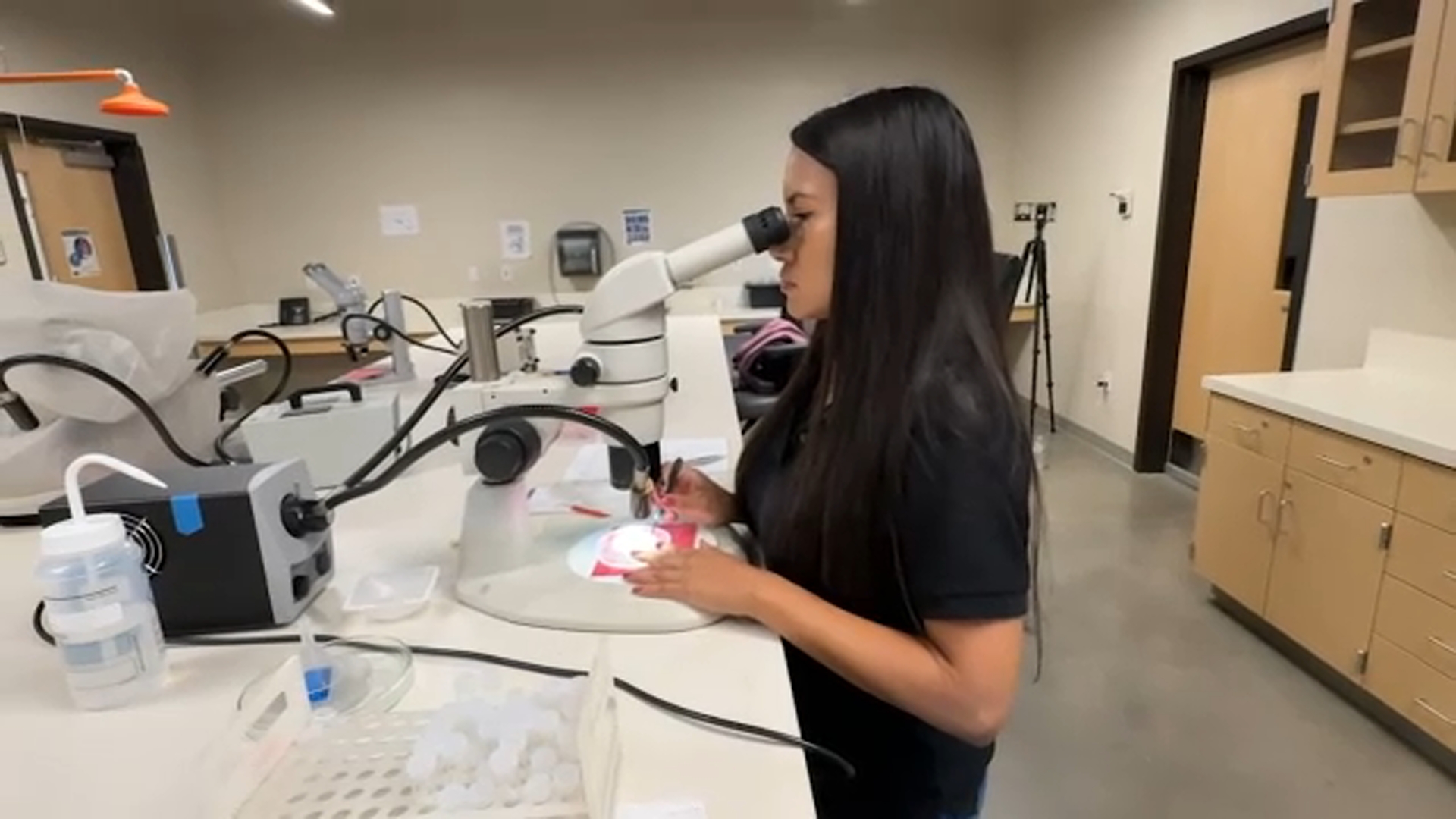


FRESNO, Calif. (KFSN) -- A Fresno State alumna's award-winning master's thesis research is opening new possibilities for tracking disease-bearing mosquitoes.
Jovana Benavides, a vector biologist and Fresno State graduate, said her research is the first of its kind.
"So our research is the first in the world to create a bacterial-based attractant in this capacity, and no one else has really done so because of contamination issues that could often occur. We decided to take a chance and implement this out into the field. Field trials alone are very difficult to conduct, and we decided to take a chance, and we got very exciting results," Benavides said.
Benavides' yearlong master's thesis project earned both a Department of Biology award and Fresno State's 2026 College of Science and Mathematics Award for Distinction in Student Research.
Her mentors praised the recognition her work has received.
"It's been thrilling to watch, and I'm so pleased that others have recognized the work that she's done as well. Obviously, we think she's incredible here," said Jodi Holeman, district manager for Consolidated Mosquito Abatement.
Benavides said the project centered on developing a new bacterial-based lure designed to attract pregnant Aedes aegypti mosquitoes in what she described as an economical, less expensive and environmentally safe way.
"It emits a volatile confound known as geosmin, which is essentially a smell of wet dirt, which we know Aedes aegypti mosquitoes are attracted to," Benavides said. "So nothing on the market currently exists for that."
As part of the research, Benavides used two types of traps at different sites: a passive AGO trap serviced at a residence once a week, and an active gravid trap serviced overnight.
"We had 160 traps out in the field," she said.
Benavides said she captured thousands of mosquitoes during the study.


"Some of those traps, I'd count 100 per trap per week," she said.
She assembled the traps herself to standardize the process and reduce potential confounding factors in the field. She also collected environmental data throughout the study.
"We were taking temperature readings, humidity readings. We wanted to see how - they are bacterial-based laws, so we wanted to see how the bacteria were growing out in the field," Benavides said.
Benavides works as a vector biologist for the Consolidated Mosquito Abatement District, which is responsible for controlling mosquito populations across most of Fresno County.
She said vector-borne disease remains a significant concern in the Central Valley and that studying new mosquito-attraction methods can aid testing and disease surveillance efforts.
"Aedes aegypti was established here about ten years ago, and although we haven't had any pathogen transmission, person-to-person transmission or local transmission as we see it, is an impending threat," Benavides said.
Benavides said the research also led to the discovery of insect species not previously seen in the Valley, according to Benavides.
"I think our next step would be to run some genetic analysis in order to specifically determine what insects we did find," she said. "I'm really happy that we at least set the groundwork for future research."
Benavides said the findings could provide a foundation for future studies aimed at improving mosquito monitoring and understanding insect populations in the region.
For news updates, follow Danyelle Burke North on Instagram and TikTok.