May 12, 2026, 4:35 PM GMT
Trump says he'll suspend federal gas tax to help address high fuel prices due to the Iran war
President Donald Trump says he'll suspend the federal gas tax to help address high fuel prices due to the Iran war.


President Donald Trump announced "major combat operations" against Iran on Feb. 28, with massive joint U.S.-Israeli strikes targeting military, government and infrastructure sites.
Following the announcement of a two-week ceasefire, initial U.S.-Iran talks in Pakistan in April failed to reach a peace deal.
Trump later announced the open-ended extension of the ceasefire and the continuation of a U.S. blockade until negotiations are concluded "one way or the other."
Please read the latest Iran war coverage here.
President Donald Trump says he'll suspend the federal gas tax to help address high fuel prices due to the Iran war.
Oil prices climbed after President Donald Trump rejected Iran's latest proposed peace deal as "totally unacceptable," with the U.S. and Iran still appearing far apart on any resolution to the war.
Oil was at nearly $98 a barrel -- up 2.5% -- in U.S. trading as of Monday morning, with global oil at $104, up nearly 3%.
The average price of a gallon of regular gas on Monday was $4.48, down 3.7 cents compared to Sunday and up $1.54 since the war started, according to GasBuddy.
Secretary of State Marco Rubio told reporters the administration expected a response from the Iranian regime on Friday, but that "only stupid countries" wouldn't respond to fire with fire when facing attacks like the U.S. did in the Strait of Hormuz.
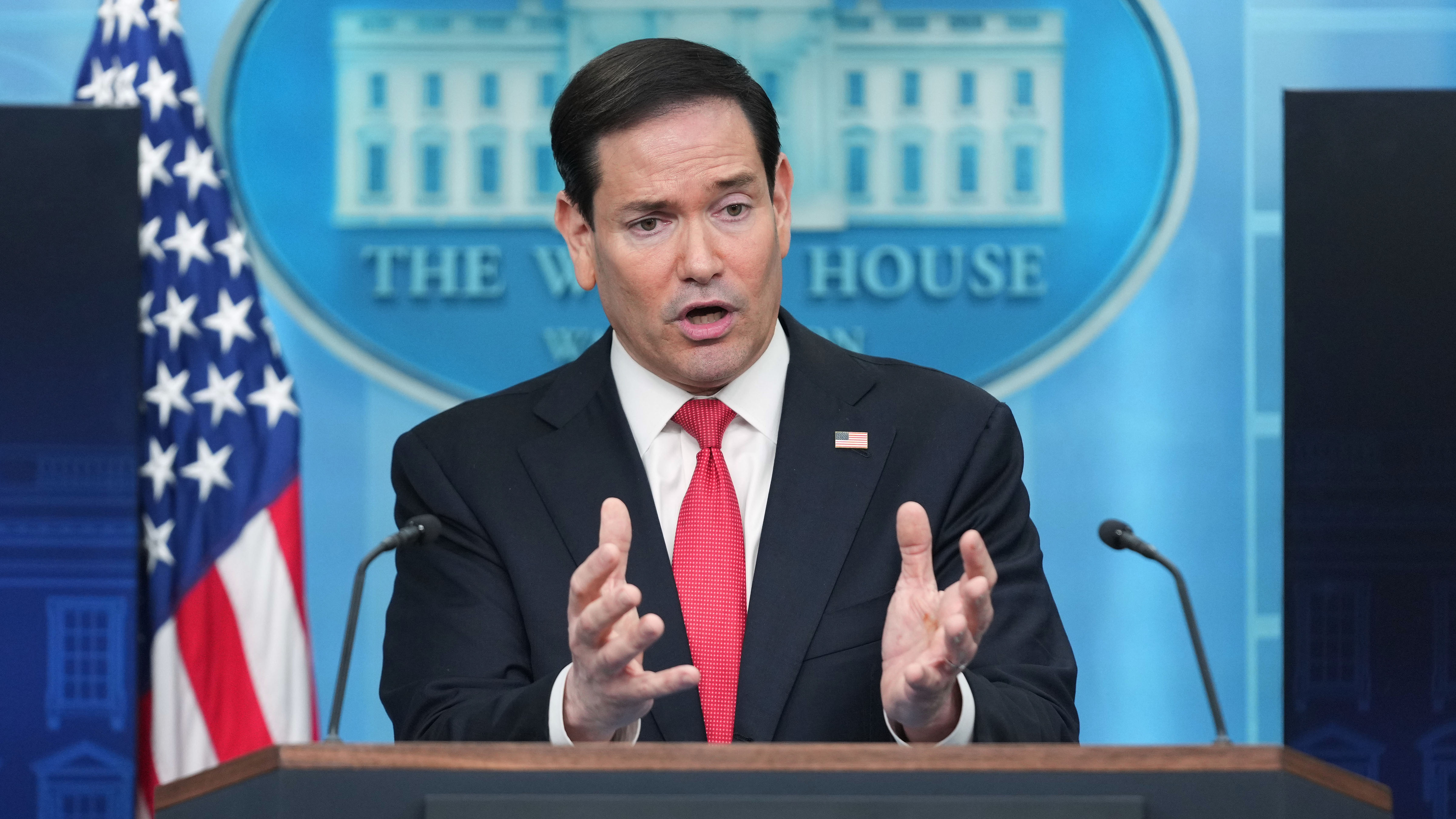
"The red line is clear: They threaten Americans, they're gonna get blown up," Rubio told reporters Friday.
"If you fire at a U.S. Navy ship, what are we supposed to do?" Rubio said. "Of course we fired back on them. They were shooting at us. That's what I would expect to do. Only stupid countries don't shoot back when you're shot at," Rubio said. "And we're not a stupid country."
On talks with the regime, Rubio said "we should know something today" and "the hope is it's something that it can put us into a serious process of negotiation."
"We're expecting a response from them today, at some point. We have not received that yet as-in the last in the last hour, but perhaps that will come. Their system is still highly fractured and a bit dysfunctional as well, so that may be serving as an impediment," Rubio said. "I hope it's a serious offer. I really do."
As the U.S. struck Iran again in what the president described to Rachel Scott as a "love tap," standing in the foundation of the drained Lincoln Memorial Reflecting Pool on Thursday, he offered a much starker picture of what the world would see if the ceasefire between the U.S. and Iran comes to an end.
"If there's no ceasefire, you're not going to have to know. You're just going to have to look at one big glow coming out of Iran. And they better sign their agreement fast," Trump said, when pressed on what the strikes meant for the ceasefire with Iran.
"But they have to understand if it doesn't get signed, they're going to have a lot of pain. They're going to have a lot of pain," Trump added. "They want to sign it. I will tell you, they want to sign it a lot more than I do."
It's not the first time the president has described the war in such severe terms.
In fact, it was exactly one month to the day on Thursday since Trump threatened that a "whole civilization will die tonight, never to be brought back again," before announcing a then-two-week ceasefire with Iran. The president says it remains in place today.